
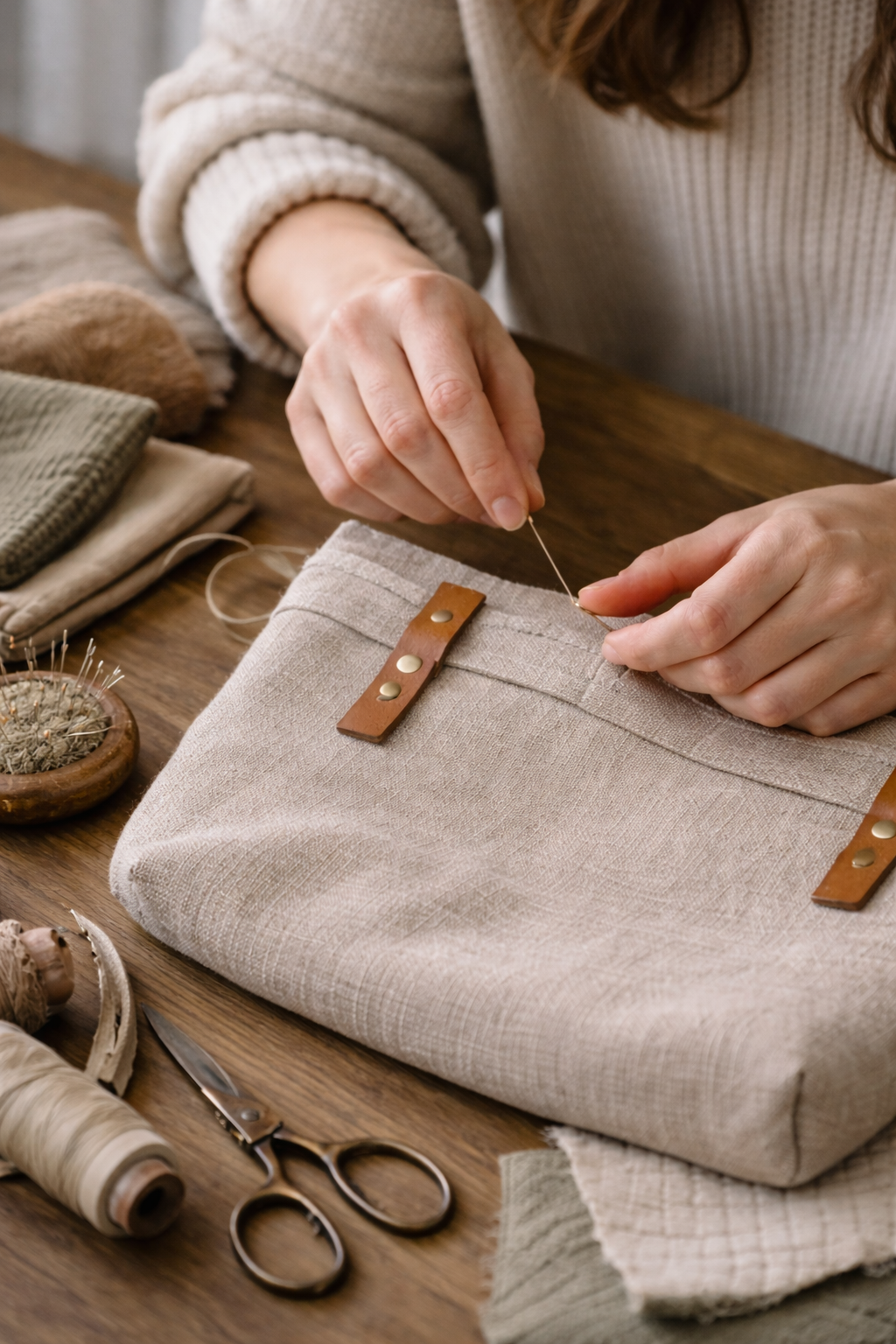
Imperfection as a Trace of Process
When something is made by hand, it passes through human judgment.
A stitch may shift slightly.
A fabric may respond differently.
A curve may be refined by eye rather than machine calibration.
These differences are not flaws.
They are traces of the process.
They remind us that someone was present in its creation.
Why Uniformity Is Not Always Better
Industrial production aims for sameness.
Every piece identical.
Every measurement exact.
Every seam replicated thousands of times.
This has its place.
But when everything is perfectly uniform, individuality disappears.
Handmade pieces resist that sameness.
They carry subtle character.
And character creates connection.
The Quiet Value of Human Touch
There is something grounding about knowing that a product was shaped by human hands.
Not rushed through an automated line.
Not reduced to efficiency alone.
A handmade bag may contain:
- Slight differences in stitching
- Natural shifts in texture
- Small marks of handling
These elements do not weaken the piece.
They give it life.
Imperfection Makes Ownership Personal
When we choose handmade, we often accept that no two pieces are completely identical.
That understanding changes how we relate to the object.
It becomes:
- Less disposable
- More personal
- More lasting
Imperfection, in this sense, creates intimacy.
Beauty Beyond Symmetry
The beauty of handmade imperfection lies in authenticity.
It reflects:
- Time
- Attention
- Presence
It does not try to compete with factory precision.
It offers something different — something human.
And sometimes, that is exactly what makes a piece meaningful.
A Different Kind of Quality
Quality is not only about flawless surfaces.
It is also about care.
About intention.
About the willingness to slow down and create something real.
In handmade work, imperfection is not something to hide.
It is something to understand.
And perhaps even to appreciate.